


upcoming solo exhibition
SOLITUDE SERIES
SERIES


SOLITUDE SERIES
The Solitude Series represents the present state of Jie Li Elbraechter’s artistic inquiry. It does not introduce solitude as a new theme,
but marks a transformation of a long-standing condition. This series is inseparable from Beijing Impressions, created during adolescence.
While the earlier works depict solitude as alienation, a sense of being surrounded by a world that remains unreachable, the current series reflects a conscious return to solitude as clarity and completion.
Colors become luminous rather than heavy; space opens rather than confines. solitude here is no longer a symptom of displacement,
but a chosen state of awareness, and a condition achieved after prolonged engagement with it.
Upcoming Solo Exhibition(2026)
Beijing Impression(2000)
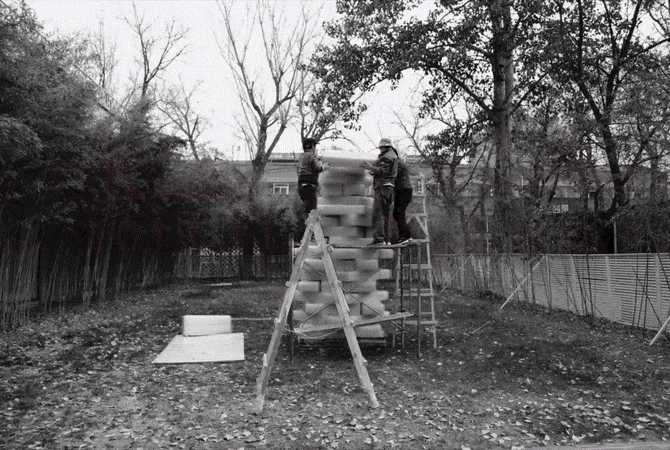
Trace (Anatman Art Exhibition in Beijing)(2019)
Trace
Trace continues Jie Li Elbraechter’s sustained inquiry into time and impermanence. The work emerges from her long-term experience of living across different cultural systems, and from close observation of how rituals, memory, and disappearance are understood and enacted in different contexts.
Drawing on Buddhist notions of impermanence, as well as philosophical and anthropological reflections on disappearance, Traces approaches vanishing not as negation, but as transformation. In these frameworks, disappearance rarely signifies absolute absence; it more often unfolds as residue, transition, or trace.
At the center of the work is a carefully constructed red ice structure, allowed to melt gradually over time. As the ice dissolves, red pigment is transferred onto rice paper, leaving marks that cannot be reversed.
Unlike the ritual logic of mandala sand paintings, which emphasize complete dissolution and return to zero, Traces focuses on what remains after disappearance. The resulting imprints do not signify attachment to form, but serve as evidence that time has passed, and that something has occurred.
Seen through an anthropological lens, the work reflects Li’s growing awareness that while cultures differ in how they understand disappearance, it almost never equates to total nothingness. What vanishes often continues to exist, as residue, as memory, or as transformed presence within time.


The Efficacy of Softness(2004)
Fulcrum(2019)
Jie Li Elbraechter’s artistic practice is grounded in sustained movement. A life lived between different countries, cultures, and social environments, while remaining anchored in a coherent and enduring set of core questions.
Her work examines how the individual confronts the structure of fate;
whether vulnerability must inevitably imply failure, and what forms of power and ethics are embedded within it;
how the scale of the human presence in the world can be understood;
whether traces remain after all things disappear;
and whether solitude signifies absence, or a state of completion.
These questions recur throughout her different bodies of work.They unfold as a continuous inquiry into fate as structure, into vulnerability as an ethical condition, into the relational scale between human beings and the world, into time, disappearance, and the persistence of traces,
and ultimately into solitude as a mode of individual completion.
Rather than emerging as abstract propositions, these concerns arise from Jie’s long-term lived experience across China, Europe, and Southeast Asia. Her early cultural training shaped her modes of perception and judgment; extended cross-cultural life sharpened her awareness of difference and structural relationships; and sustained reflection gradually transformed artistic practice into an anthropological way of seeing.
This approach was further systematized through her doctoral research in art anthropology, allowing lived experience, cultural structures, and artistic practice to converge into a coherent methodological framework.Her works do not exist as isolated series, but as an interconnected and continuously returning system of thought.
Painting, installation, and moving image function not as separate media, but as parallel modes of inquiry, operating across different stages of life, cultural contexts, and material forms. Together, they repeatedly test the same fundamental concerns, time, eternity, and solitude—in order to explore how the individual situates herself within fate, history, and the passage of time.
The Utopia of Softness Series
The Utopia of Softness emerged from Jie's long-term experience of living within European social and cultural structures, and has since reappeared across different stages of her practice. Within this series, resistance is not understood as direct confrontation. Instead, Jie approaches reality and fate through softness, humor, and persistence, modes of response that operate outside the logic of force.
Across painting and installation works, including her participatory project The Efficacy of Softness presented during the Münster Architecture Festival, fragile materials, provisional structures, and fragmented subjectivities gradually accumulate. Straw, unstable constructions, and dispersed actions form spaces that are shaped not through orchestration, but through uncertainty and collaboration. Viewers’ participation is neither heroic nor monumental; it unfolds as a series of small, contingent gestures that together generate a palpable sense of presence.
Later works, such as the Egg and Stone fulcrum series, resonate with Jie’s long-term engagement in social and charitable practices addressing marginalized communities. In these works, weakness and ordinariness are not framed as deficiency or lack. Rather, through repetition, duration, and co-presence, they reveal a form of efficacy that does not rely on visible strength or dominance.
This understanding grows out of Jie’s sustained cross-cultural observation and reflects an ongoing inquiry into social structures. Power, in her work, is not confined to explicit confrontation or overt displays of force. It also operates within gaps, margins, and everyday conditions, where softness is capable of forming its own order, and of exerting a quiet yet persistent influence on reality.

A World in a Grain of Sand
is an important body of work completed by Jie Li Elbraechter in Singapore in 2018, reflecting a moment of reconsideration after extended cross-cultural experience. The series revisits questions of scale, wholeness, and how the individual is situated within the world.
Using natural materials such as sand, glass, and hand-fired mosaic fragments, Jie begins from the smallest units of matter. Through slow, repetitive, and sustained processes of construction, the works unfold as meditations on how structure and meaning emerge through accumulation rather than monumentality.
Rather than depicting a grand cosmology, A World in a Grain of Sand focuses on the latent order embedded within the minute. A single grain of sand becomes both a material fragment and a condensed image of the whole.
Drawing together reflections from Eastern philosophy and contemporary thinking on dimensionality and wholeness, the series invites viewers to reconsider scale, not as a measure of size or importance, but as a way of understanding how the individual remains continuously embedded within larger, interconnected systems.

COMPENDIUM OF MATERIA MEDICA
Compendium of Materia Medica marks a return to Chinese cultural foundations, now approached from a transformed perspective.
Rooted in early ink training and traditional Chinese thought, the series juxtaposes medicinal plants with Western pharmaceuticals, revealing tension between holistic and reductionist systems of knowledge.
This return is not nostalgic. It reflects an analytical re-engagement with tradition, shaped by years of external cultural experience.


FATE, Beijing
ATTITUDE, Germany
CIGARETTE, France
2 Me, England
Memory, SH& SG
Portraits Series
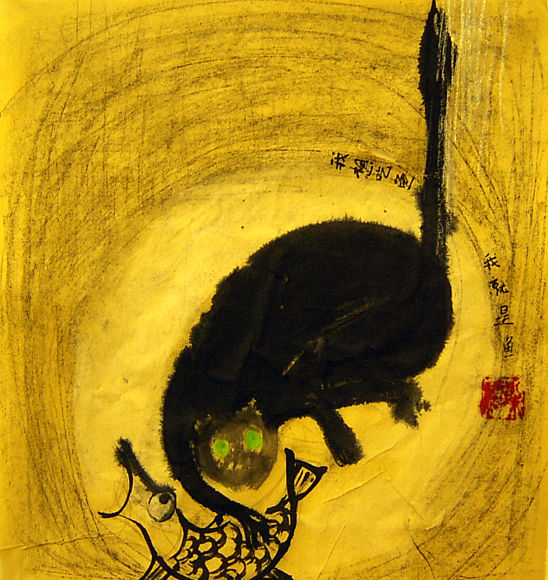
Since 2000, portraiture has been a recurring and enduring element in Jie’s artistic practice. Across different places and cultural contexts, she repeatedly returns to the human figure, or animal figures imbued with human qualities, as a way of engaging with lived experience.
These works are not concerned with identity as a fixed category, nor do they aim to construct stable characters. Instead, they function as ongoing records of states of being. Facial expressions, gestures, and silences register how individuals confront everyday pressure, emotional tension, and the passage of time.
From early works to more recent paintings and installations, the figures gradually shift from specific likenesses toward more generalized forms of existence. The boundary between human and animal is deliberately blurred, allowing the images to move away from personal portraiture and toward a shared condition of vulnerability, endurance, and struggle.
In Jie’s work, portraiture is a sustained practice rather than a discrete theme. It serves as a site where personal experience, historical atmosphere, and the question of how life persists under constraint come into view—leaving behind visual traces of what it means to remain alive.

INK AS METHOD
Before forming her contemporary language, Jie underwent six years of systematic ink training in China.
Ink shaped perception rather than style, introducing rhythm, breath, emptiness, and duration.
After relocating to Geneva, she returned to ink for two further years. Removed from its original cultural framework, ink became a structure to be dismantled, tested, and reassembled.
This methodological foundation underlies her later cross-cultural practice, bridging tradition, displacement, and anthropological inquiry.
Yantai, China
Geneva, Switzerland